OGC Theatre | OGC news
Content is from the site's 2004-2005 archived pages of music review posts and other ramblings from Jeff.
Once a month I would check into this site to see what was posted. There was always some nice little nugget if info to mentally ingest while I sipped on some nice home brewed coffee and a robust breakfast of eggs, greens and Japanese sweet potatoes. The morning I was reading the 2005 post about The Old Grey Cat's Unofficial Laura Nyro Page was memorable not only because I love Nyro's music and lyrics, but also because it was the morning my two cats decided my breakfast table was the perfect place to play "Catch Me if You Can". Breakfast and coffee ended up on the oriental carpet beneath the table leaving a nice mess that would need professionally cleaning. A frantic web search led me to a fantastic carpet cleaning company, who after saving my heirloom carpet and been my "go to" carpet cleaner ever since. The number of friends I have recommended to them should earn me a bonus, or at least a discount for carpet cleaning. However, that morning which started out great since there was a post on the OGC Theatre website, to despair after the cat disaster, to redemption when Hiam showed up and assured me my carpet would be ok, made that day quite memorable to say the least.
The OGC Log 2004
+++
July 2004
7.4.2004 - Yes, yes, I've been slacking big-time the past month - few dispatches and even fewer updates. No excuses other than: Juliana Hatfield's In Exile Deo. One of the best albums of the year, says I, if not the best, though Maria McKee'sLive in Hamburg (due July 27th) may just give it a run for its money. We'll see. This month, Diane chimes in on the "Album of the Month" - Patti Scialfa'swondrous 23rd Street Lullaby, which was released June 15th:
Patti Scialfa's 23rd Street Lullaby is a poignant and beautiful sliver of shimmering 60's-era soul, served up with memorable melodies, impeccable production and an updated Phil Spector feel that just won't quit. From the title track to the last song ("Young in the City"), this CD takes you to Scialfa's version of NYC, a little bit Lou Reed, a whole lot of Jersey Girl-comes-to-the-big-city, determined to take her shot. She may get roughed around a bit, but she emerges from the wet asphalt unscathed and reborn. The lyrics can occasionally verge on awkward ("he's the walking definition of what it is to be mean"), but the sound is pure and right and perfectly evocative (and didn't Phil Spector's lyrics get brutally mocked way back when...and don't those songs hold up in the Light of Day 40 years down the road?). Bonnie Raitt (or Marcia Ball) could do a mean cover of "City Boys," but Patti does just fine on her own. While others have heard traces of Laura Nyro, I think the only connection there is the "Up on the Roof" ambiance--Nyro was a Native New Yorker, after all. Still, 23rd Street Lullaby has the thematic unity and aural cohesion (if not the innovative brilliance) of Nyro's classic paean to her hometown, New York Tendaberry.
Diane also spotlights the new archival Laura Nyro release, Spread Your Wings and Fly: Live at the Fillmore East May 30, 1971.
--Jeff
+++
December 2004
12.29.2004 - One of the nice benefits to running OGC Theatre in all of its ramshackle, infrequently updated glory arrives every three months: I receive a gift certificate from Amazon for the monies the site's earned during the previous quarter. I.e., every time someone clicks on one of my Amazon links and buys something, I score a tiny cut of the proceeds. In total, it usually doesn't add up to much - between 20 and 30 dollars - but it's nice all the same. Very nice in that I can then turn around and, in my indecisive deliberations, go back and forth on what to get with it. Such was the case with the $32 I earned for the third quarter of '04. There was much I wanted (there's always much), and honing in on one or two choices took so long Diane was beginning to wonder if I'd ever make a choice.
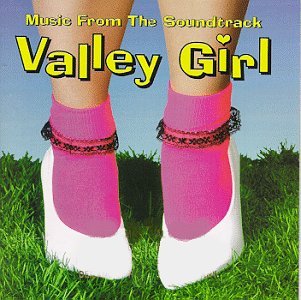 I decided, finally, to go with the Valley Girl DVD - it's a movie she had fondmemories of and one that, while I'd never seen it, I thought I'd like. And, indeed, I did. It's not a great movie by any means - but it is fun with a capital F. It ably captures the flavor of the early ' 80s while relaying the basic plot that anchors many a teen flick: a girl (Deborah Foreman) falls for a guy (Nicholas Cage) from the wrong side of the tracks. It also features a rollicking soundtrack - the most notable song is Modern English's incredibly catchy "I Melt with You." (I saw them in 1983 when they opened for Roxy Music). Also featured: the Plimsouls, Josie Cotton and the Flirts. As much fun as the movie itself are the DVD bonus features. Nicholas Cage, in all of his Elvis-like glory, sits down with the film's director, Martha Coolidge, for a fascinating conversation; and there's a way-cool documentary that hones in on the tubular soundtrack, with the various performers (few of whom went onto be a major act) discussing their histories. The singer from Modern English, for example, recalls how Modern English was playing to, at most, 200 mostly indifferent club-going folks a night in England when "I Melt with You" - thanks in large measure to MTV - became a major hit over here. They flew into Florida for their first gig (dressed for cold weather, no less) and in short order played to a crowd of 10,000 screaming fans who knew all of the words to their songs. Okay, he's probably exaggerating a might with that - what other songs could the fans have known? I was 18 in '83 ... the only Modern English song anyone knew was "I Melt with You." Which, I might add, is as addictive as it ever was.
So, all that's a hint for this: my Album of the Month is Music from the Soundtrack of Valley Girl. It wasn't the official soundtrack, which was way-laid in '83 due to a licensing mix-up. (If anyone has the original on vinyl, as a few - as always - slipped out, get this: it's worth $150, easy.) Anyway, this "soundtrack" was put together in the mid-'90s - an homage, if you will, to a movie that personifies the early '80s as well as any other. Better than any other, almost. Among the gems: the Plimsouls' hit-that-should-of-been "Million Miles Away"; Josie Cotton's incredibly funky and funny (and Go-Go's-like) "Johnny Are You Queer" and almost-as-catchy "He Could Be the One" and "School Is In"; and, yes, Modern English's "I Melt with You."
Another real treat this month has been a TV series we missed the first-time around, but are catching up with on DVD: Buffy, the Vampire Slayer. You may say it's staked us as fans. Seasons One, Two, Three and Four have been a load of fun; we're expecting the same from Five, Six and Seven, too. –Jeff
+++
September 2004
Sept. 7th, 2004 - Yes, yes, late to the game again ... been grooving to the max with the iRiver. Until today, I had it filled with what might be called a Juliana Hatfield mega-block - 51 songs, in all: the Blake Babies old and sorta-new ("Disappear" has re-emerged as a fave anthem of mine), the one-off Some Girls, plus heaps of Juliana on her own. In Exile Deo is, hands down, my album of the year thus far. It has it all: jangly guitars, irresistible melodies and lyrics that delve deeper than your average pop song (see "Because We Love You"). At the same time, I've fallen in love - again - with Juliana's sublime Beautiful Creatures, from 2000. An overlooked gem, it is a bit more laid-back than In Exile Deo, but no less powerful. "Cry in the Dark" makes the heart ache ... of course, to quote the bard-ess, "a heart that hurts is a heart that works."
Anyway - onward to September's Album of the Month - Steve Earle's hard-hitting The Revolution Starts Now, which I've been cranking up in the car. Folks who've visited the site through the years may recall that, once upon a time, we had a Steve Earle section - some of it is now available in The OGC Compendium (thanks to all who purchased it, by the way). The reason we took the section down had nothing to do with Earle's music, just time: there's not enough of it in the day to get everything I want to do done. I'm as much a fan as ever, in other words. Revolution is a hard-hitting, politically charged collection of songs that should sate anyone who leans left (as I do), the title tune and profane "F the CC" especially. And, too, the Emmylou Harris duet "Comin' Around" reverberates through soul. No, it's not his best work, but the highs here match the best he's done. And because I am a fairly political person, I will overlook the few flawed songs.
On other matters - as I mentioned, I do lean left. Hence the newsfeed on the left. David Brock's Media Matters website does an excellent job of collecting the misinformation (and outright lies) many political pundits and reporters pass on as truth. (So does his recent book, The Republican Noise Machine.) Sometimes, yes, it goes a tad overboard ... but what the hell? –Jeff
+++
August 2004.
8.27.2004 - Good news, music fans. MusicMatch 9.0 supports the iRiver player ...
8.8.2004 - Egads. I'm still slacking ... but with a purpose: For the past few weeks I've been enjoying a remarkable little gadget: the iRiver IFP-790 MP3 Player, which Diane and our friend Luanne bestowed upon me for my 39th birthday last month. It's a 256mb flash-memory device that holds about 40 songs when they're encoded at 192kps (more, obviously, if you encode at lower rates).
IMAGE: 2004-a-girl-called-eddy.jpg
The big plus, for me, is that I can record with it - both through a microphone and from the stereo. Thus far, I've encoded two wondrous Natalie Merchant shows from 1988 and '98; a 1983 Stephen Stills gig; and, for Diane, a Lou Ann Barton concert from 1985 and a Nanci Griffith show from 1992. (Up next: a few vintage 10,000 Maniac gigs.) In between, I've been feasting on Bob Seger's songbook ... one of my favorite artists of all time who I've returned to w/a vengeance of late. Now playing: "Understanding," a gem from the Teachers soundtrack that's on his Greatest Hits Vol. 2. About the only downside? My download site of choice, MusicMatch, doesn't support the device. So, if I want to take my downloads with me, I have to burn the WMAs onto a CD and then rip 'em back as MP3s ... a cumbersome process that has me on the lookout for a new download service. (I blame MusicMatch - and the RIAA - for the lack of compatibility, not iRiver. It's amazing how mind-numbingly dumb they are with the many restrictions they place on the tracks. But that's a post for another day.)
Anyway, onward to the Album of the Month ... and, for the second month in a row, Diane does the honors for the very seductive A Girl Called Eddy's self-titled album.
"Forget Joanie and Chachi. The Erin Moran we care about is A Girl Called Eddy, a Neptune, NJ native who crafts sweet and poignant melodies and troubled lyrics that she sings like a haunted angel with a great jukebox. While the Dusty Springfield influence is acknowledged, there are shadows of Dionne doing Burt Bacharach, Everything but the Girl's Tracy Thorn--and even the good songs by Carpenters ("Rainy Days and Mondays," "Superstar"). Despite these influences, Eddy is her own girl, a siren who lures us with her tender voice, a hypnotic production and songs as compelling as Circe herself. Highlights include the single, "Somebody Hurt You," a track so timeless my husband swore he heard it before, the soulful "People Used to Dream About the Future" (which you can download for free from her website), and "Tears All Over Town," a mid-tempo pop gem. But there's not a bad track on the CD."
One more recommendation. No, not Maria's Live at Hamburg (the obvious choice, I suppose). Instead, I'm checking in with what might be called my "Retro Album of the Month" ... Bob Seger's Against the Wind. Not his best album by any means, but still one of my all-time favorites. "You'll Accompany Me," "Her Strut," "No Man's Land," the title tune and "Shinin' Brightly" are, to my ears, as good as songs come. "No Man's Land" especially - "sanctuary never comes without some kind of risk." Truer words never spoken, ya know?--Jeff
+++
July 2004
7.4.2004 - Yes, yes, I've been slacking big-time the past month - few dispatches and even fewer updates. No excuses other than: Juliana Hatfield's In Exile Deo. One of the best albums of the year, says I, if not the best, though Maria McKee's Live in Hamburg (due July 27th) may just give it a run for its money. We'll see.
This month, Diane chimes in on the "Album of the Month" - Patti Scialfa's wondrous 23rd Street Lullaby, which was released June 15th:
Patti Scialfa's 23rd Street Lullaby is a poignant and beautiful sliver of shimmering 60's-era soul, served up with memorable melodies, impeccable production and an updated Phil Spector feel that just won't quit. From the title track to the last song ("Young in the City"), this CD takes you to Scialfa's version of NYC, a little bit Lou Reed, a whole lot of Jersey Girl-comes-to-the-big-city, determined to take her shot. She may get roughed around a bit, but she emerges from the wet asphalt unscathed and reborn. The lyrics can occasionally verge on awkward ("he's the walking definition of what it is to be mean"), but the sound is pure and right and perfectly evocative (and didn't Phil Spector's lyrics get brutally mocked way back when...and don't those songs hold up in the Light of Day 40 years down the road?). Bonnie Raitt (or Marcia Ball) could do a mean cover of "City Boys," but Patti does just fine on her own. While others have heard traces of Laura Nyro, I think the only connection there is the "Up on the Roof" ambiance--Nyro was a Native New Yorker, after all. Still, 23rd Street Lullaby has the thematic unity and aural cohesion (if not the innovative brilliance) of Nyro's classic paean to her hometown, New York Tendaberry.
Diane also spotlights the new archival Laura Nyro release, Spread Your Wings and Fly: Live at the Fillmore East May 30, 1971.--Jeff
+++
June 2004
6.5.2004 - Juliana: "I'm a goddess in your eyes/and I will never die/I was born of people's needs/and what they don't want to believe/but I'm a liar, that's the truth/go home and think it through ..."
Those lines come from what is, without doubt, one of my all-time fave songs by Juliana or anyone - "Got No Idols," which can be had in a scintillating electric version on her early '90s album Become What You Are. She also released a sparse, piano-only version as a bonus track on the "For the Birds" CD single that's positively spine-tingling. I've probably put them on more tape and CD mixes through the years than any other song, often leading off with one and closing with the other. Why? The song deconstructs the "rock god" syndrome many fans fall into and flips it on its head ...
I almost included it on May's home-recording project (Pop Tarts Not: Ear Candy, Vol. 1), but decided against it at the last minute. Why? Why do ya think? Here's June's home-burning project: a 78 minute, 40 second opus I've dubbed ... Got No Idols: The Best of Juliana Hatfield. Of late, I've been alternating it with In Exile Deo, which is hands-down the best new CD of 2004 thus far ... one (of many) songs that's stolen my affection is the blast of pure pop "Sunshine":
"Everybody gets down sometime/you get happy with a sugar buzz/white chocolate is your favorite drug ..." It's a delectable and intoxicating outing, the kind of upbeat tune that couples soul-cleansing confessions with unfettered optimism - and a melody that can't be beat. "I've been sleeping through my life/now I'm waking up/and I want to stand in the sunshine ..." Give it a go if you haven't, already.
6.1.2004 - If it's the 1st, it can only mean one thing: it's time to name a new Album of the Month. And, as the above photo of Juliana Hatfield indicates, the honors go to In Exile Deo, her latest CD, which was released May 15th. It is, in short, a tour de force that's packed with tasty, guitar-driven melodies and lush, to-die-for vocals - and may well be her best recorded effort yet.
From her days with the Blake Babies in the late '80s to her alterna-pop solo work in the early '90s, it seemed as if the indie star was on the verge of achieving mainstream success. With the Blake Babies, she capped the 1980s with one of that decade's best albums in Sunburn; and then released a trio of good-to-great albums (Hey Babe, Become What You Are, Only Everything) before fading from earshot. She returned in 1998 with the burning Bed, a glorious, gut-first exercise of electric rock and pop that, again, failed to push her over the top. 2000 saw her release a two-fer: the red-hot metal of Julia's Pony: Total System Failure and the more subdued, introspective Beautiful Creature. "Introspective." That may well be the keyword for Juliana's recorded oeuvre as a whole, and the reason why she's failed to catch on to a wider audience. With her wistful, vulnerable vocals and oft-wounded lyrics set aside sarcastic, spiteful rejoinders accented by jangling guitars, listening to a Juliana album can, at times, feel like you're listening to an audio diary.
In Exile Deo maintains that feel. Many songs ache; others mix sly asides with brash confessions, and diatribes about fighting and feeding addictions, be they to love, to drugs, to cigarettes ("Forever"). "Tourist" is one such high, Juliana's voice filled with empathy and more. The acoustic "Tomorrow Never Comes" quivers with hurt and regret. "With a little lovin' and time/you might forgive me," she intones, her voice threatening to break. It's fragile beauty in a song. Fragile beauty buttressed by strength, I hasten to add.--Jeff
+++
May 2004.
5/30 - Frontline "reported" Thursday (5/27) on the sales slump that's ensnared the record industry the past few years. As always, these days, pot-shots were taken at various pop artists ... with specific artists (Britney Spears, most notably) singled out for blame. David Crosby, interviewed at length during the course of the program, quipped that "Britney is as shallow as a bird bath" and, in essence, said she's symptomatic of the record industry's ills. Yes, because everyone knows the music of the '60s was "deep." The Mamas & the Papas ... deep? The Supremes ... deep? The Monkees ... deep? Give me a break. I could go on for hours here, spitting out pop artists from bygone eras whose music was, is, will always be ... fun to listen to, but not "deep." (Check out Rhino's Have a Nice Decade series for a lot of pop fodder from the 1970s, for example.) As Paul Simon once sang (in "Boy in the Bubble" from Graceland), "every generation throws a hero up the pop charts." Every generation also creates its own pop and rock stars. Yeah, maybe the record execs can "create" a hit once ... but twice? Three times?
No. Consumers may get rooked once, but that's it. We see and hear through the hype ... hell, think of the many expected hits through the years that missed. To be blunt here: The record industry's slump is not a result of Britney Spears or any other "pop" artist currently topping the charts. Rather, the slump is the result of several factors that dates back to the late '70s and early '80s, when the music industry again faced a big drop-off in sales ... only to be saved by the CD revolution in the mid '80s. Those of us old enough to have amassed large LP collections by then essentially, slowly and methodically, re-placed many of the same albums with the CD equivalent. My trek began in earnest in 1987; and stopped, for the most part, in the late-'90s. Nowadays, I just buy new releases ... or download specific songs from MusicMatch.
Younger music fans, however, don't have back catalogs to replace (and here's hoping they never will). At the same time, the consolidation of the many record companies into the few, and the expansion of radio station ownership, has totally changed the way music is made and sold. There are fewer outlets for new music to be heard; and new artists are given less time to succeed. Give young musicians a chance to grow - few are gonna hit homeruns their first time up at the plate.
At the same time, don't blame those who manage to succeed for the ones who don't. If they're selling CDs, regardless of whether or not you like them, it's obvious - to me, at least - that they're connecting with someone. What is it John Lennon sang? "Whatever gets you through the night, it's alright"? So true, so true. Plus, think of it like this: the profits the pop acts bring in essentially enable the labels to continue to support lesser-selling artists. At least, that's how it once operated. Nowadays? I'd wager those profits go into the pockets of the record-company men (and women).
(One last thing: Crosby's wrong. "Shallow" Britney's last album, In the Zone, is one of the strongest albums I've heard in the past year ... it'd make my top ten, easy.)
5/27 - For a short time, I've re-posted my interviews with Crosby, Jeff Pevar, Stephen Barncard & other CSN-related folk. Check out the Contents pages for links. If you like what you read, buy the OGC Compendium.
On another front: I logged onto MusicMatch earlier tonight to peruse its vast, if frustrating inventory of songs and what's one of the "recommended" tracks? Lone Justice's "I Found Love"! Yowza. A great song, but I'd say don't buy the song ... buy the album This World Is Not My Home instead. Lone Justice, of course, was Maria McKee's old band ... and, as I wrote in my review of that compilation way back when, "Fuck the Beatles. Fuck the Stones. And, while I'm at it, fuck Bob Dylan and Neil Young, too. Written in jest? No. While listening to this combined best-of/rarities collection, that's exactly what I think ..."
Oh, and Ashlee Simpson's "Pieces of Me"? Damn good. Download it (legally, of course) if you can ... and pair it with this recommendation: Michelle Branch's "Are You Happy Now?," which I downloaded last December and am still enjoying. (Same for Michelle's "Breathe," another gem.)
5/26 - We just finished watching a wonderful music DVD: Garland Jeffreys' Hail! Hail! Rock 'n' Roll Live, which features a 1992 appearance of Garland's on a German TV music show - essentially, a mini-concert. It's nine songs; and features one kick-ass performance after another. Highlights include "Racial Repertoire," which is punctuated by a glorious snippet of Marvin Gaye's classic "What's Going On," and Garland's own "I May Not Be Your Kind," "Don't Call Me Buckwheat" and the classic title tune. Great stuff.
Turning from the serious side of music to some fluff-n-stuff: Ashlee Simpson's "Pieces of Me" is a song well worth downloading. If big sister Jessica is a little bit pop (okay, a lot pop), Ashlee's a little bit punk ... oh, alright: pop-rock. She sounds a bit like Michelle Branch. In fact, the song sounds a lot like one of Branch's. (That's not a knock against Ashlee, either. Just an observation.) If the rest of her debut album, which is due July 20th, is half this good ... egads. Talent must run in the genes. And jeans.
Another fun find: Kylie Minogue's "Slow." I've heard a lot about the Aussie superstar, but never actually heard her. The song is as sexy and saucy a song I've heard since Britney's delectable "Brave New Girl." In fact, her vocal mannerisms are very reminiscent of Britney's ... or maybe that should be the other way 'round? Whatever, I have a hankering to buy the parent CD, Body Language, now.
5/24 - Well ... I've finally managed to hear a crappy 96-kbs MP3 of Hilary and Haylie Duff's take on the Go-Go's "Our Lips Are Sealed." Why do people even bother encoding at that level? It's the big plus of MusicMatch, which generally encodes stuff at 160-kpbs - the higher the number, the better the sound quality. The larger the file, too, but ... some sacrifices are worth it. Anyway, I won't say where I found the MP3 in question other than I Googled for it and, to my surprise, there it was ....
To the point, though: despite the lossy, lousy sound, I found myself boppin' along to the the Duffs' version ... and delving into the collection for a long-ago favorite, ex-Go-Go Jane Wiedlin's self-titled solo debut, which came after the group's swan song, Talk Show, which featured one tasty treat after another ... and the heart-stopping Wiedlin-penned "Forget That Day." It's easy to hear why Belinda Carlisle sang lead; hers was the more honeyed, radio-friendly voice (as evidenced by her solo success, no doubt), whereas Wiedlin's is something of an acquired taste. I love it, myself. Anyway, from the looks of it, her debut's now out of print - it goes for $25 (or thereabouts) via Amazon ... you can probably find it cheaper elsewhere. Whatever, do keep an eye - and ear - out for it. You'll be glad you did. (Belinda's Greatest Hits is another surefire pop treat - "Heaven Is a Place on Earth" is probably my fave of her solo stuff, tho' "Mad About You" still packs a wallop.)
5/23 - I've added a Google Search so folks can ... what else? Search the site and the web. I've also loaded up a few links to mostly general purpose sites that I frequent. Check it out!
5/22 - We saw a funny and inventive film today: Mean Girls. It stars Lindsay Lohan; and was written by - and co-stars - SNL's Tina Fey. Essentially, fresh from a life-long stint of home-schooling (in Africa, no less), Cadie - pronounced "Katie," as she explains - adjusts to the jungles of ... the American high school social scene. In other words, she's landed in suburban Chicago for 11th grade. Lohan, as in the delightful Freaky Friday, is a pint-sized comic goldmine. Likewise, the supporting cast - led by Fey and Lizzie Caplan (little Millie Cooper from Freaks & Geeks!!!) - sparkles.
5/21 - Here's a way to feel old fast: read this MTV News report about the Hilary & Haylie Duff duet on "Our Lips Are Sealed." The way Hilary - who's 17 - talks about the song and video shoot, one gets the distinct impression that she never heard of the Go-Go's before, let alone listened to them! "The video is awesome," she then says, noting that "we were in a car driving around the city and we were in a fountain." Is my memory going or ... isn't that what the Go-Go's did in their "Our Lips Are Sealed" video?! I remember them driving around L.A. in a car, that's for sure. A fountain, too. You can't hold it against Hilary - she's 17, after all, so her knowledge of rock/pop history has just begun. But ... egads. Call me the Old Grey Cat, indeed. (Damn, the Go-Go's were good, though. A pop band, yes, but shades of punk - and plenty of talent -tossed in for good measure. Give Talk Show a whirl if you don't believe me.)
+++
April 2004.
4/30 - Nelly Furtado's Folklore. It's a strong sophomore set from the talented songsmith that, best that I can tell, sunk like a stone since its release late last year. Furtado's 2000 debut (Whoa, Nelly) was spiced by the utterly timeless single "I'm Like a Bird." That's a song that ... let's just say I've put it on a ton of home-made compilations since. While there's no one song on Folklore that's quite that catchy, a few come close--the second track, "Powerless (Say What You Want)," especially. The lyrics speak for themselves: "Paint my face in your magazines/make it look whiter than it seems/paint me over with your dreams ..."). I'm not sure how many folks download from the legitimate music sites--I use MusicMatch on occasion, myself--but if you do, look for it. If it's not there, e-mail 'em and ask "why not?" Or ... buy the album. It's worth the investment.
4/28 - We'd like to thank those folks who've purchased The OGC Compendium and its spin-off, the Special Edition, this past week ...
4/18 - If you've visited these pages before, you know that Diane and I always endeavor to entertain, educate and offer a fan-first, occasionally hyperbolic perspective on music. We've collected much of our Old Grey Cat-related work into what we call "The OGC Compendium." It's a tote-able, 226-page paperback book that includes much of what was once on the site in one handy, tote-able tome. The price: $17.99, which is mostly due to the print-as-you-go publishing scheme. For folks who'd just like the CSN/Y content, we also have a slimmer "special edition," priced at $13.99, that just spotlights them. (The same 132 pages of CSN/Y-content appears in both volumes, so don't buy both.)
4/11 - Ah, tax season. I hate it - but, as always, there's some good music and video around to ease the pain. Earlier today and yesterday I listened to what would've been one of my Top 5 albums of 2003 if I'd bought it in 2003 ... Britney Spears' In the Zone CD. Yeah, yeah, I can hear the complaints, sighs and raised eyebrows now. My retort: Get a life! It's pop music. Pop has its place. It can be cool. It can be hip. And it never hurts when the person singing the songs is a babe ...
Fact is, it's a damn fine album - surprised the hell out of me, I'll admit, as I'd bought into the media-driven backlash most folks my age (late 30s) read and hear when it comes to Britney. But since receiving a promo copy of In the Zone in early March, I've listened to it more than any other CD in my collection. From the taut trip-hop of "Breathe on Me" to the sultry "Early Morning," the pure pop of "Toxic" and the wink-wink humor of "Outrageous," to say nothing of the utter joy that is "Brave New Girl," the beats, melodies, Britney's intoxicating vocals, the music and album as a whole, takes me there, wherever there is. My recommendation: download "Early Morning" ... give it a chance. Then move onto "Brave New Girl" and the others.
The other item that's taken me out of tax hell: the Freaks & Geeks DVD box set. If you never saw the short-lived series when it ran on NBC from 1999 to 2000, it's the story of high school-aged Lindsay (Linda Cardellini) and her younger brother Sam (John Daly) coming to grips with the complexities and contradictions of life, circa 1980. There's none of the touchy-feely (i.e., manipulative) moments that pockmark most domestic dramas, past or present. Rather, the show is accented by the awkwardness that comes part and parcel with being a teenager. Don’t get me wrong--it’s funny, too. Hilariously, laugh-out-loud funny. But unlike the many hackneyed sitcoms, dramas and reality shows that litter the networks’ lineups, the humor is organic, arising from honest interactions between the characters. Do yourself a favor: buy the box set. Amazon has the 6-CD version (perfect for all but the utter diehards) for a reasonable price. (Diehards would do well, however, to pick up the limited edition 8-CD set from the F&G website.)
4/3 - My Album of the Month for April: Janet Jackson's Damita Jo. It's filled with melodies that slink, knead and seduce the soul. If you download music from the likes of MusicMatch, Napster or I-Tunes, "Spending Time with You," "Moist," "I Want You" are three songs well worth the dollar investment.--JGG
The OGC Log 2005
The Old Grey Cat's Unofficial Laura Nyro Page
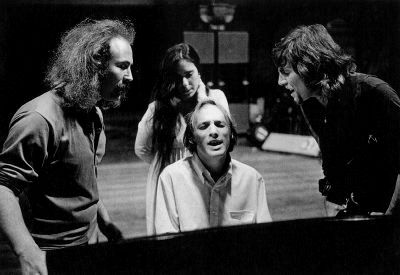
Crosby, Still, Nash & Laura Nyro, 1970; photo courtesy of Henry Diltz
My first introduction to Laura Nyro was at camp. My counselor played Eli and the Thirteenth Confession over and over. I was the one who never complained. Since I didn't have a stereo at the time (talk about child abuse), time blurs until my best friend got Gonna Take a Miracle. All that great R&B, some familiar favorites ("Gonna Take a Miracle," "Nowhere to Run") along with some new magic ("Monkey Time," "The Bells") had me seeking the originals (Major Lance and the Originals respectively). In college, my roommate asked if I had to play it quite so often. As the years passed, Nyro became one of my favorite artists, and I eventually bought all of her recordings. When she emerged from her performing hiatus, I flew to Boston to check her out at Nightstage and was less than impressed with her onstage persona. She seemed to ignore the audience, totally wrapped up in the music. In retrospect, it is the Laura Nyro I admire so much. The music always came first for her.
Laura Nyro died this year of ovarian cancer. She was 49. The tribute album, planned prior to her death, came out earlier than planned, I guess as a response to the shock of her death. I still can't believe she's gone. She left behind more than "one child born in this world to carry on"--the legacy of her music is a truly great gift.
Laura Nyro - Live from Mountain Stage - Blue Plate Music
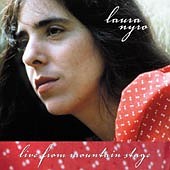 Those of us who are Laura Nyro fans from jump street are thrilled to have another CD to play ad infinitum (and some of us--the hardcore fans--already have these songs from taping the performance on Mountain Stage when it originally aired). Having it on CD, with sound so clear I feel like Laura is singing to me from my living room, is a whole new ballgame, however. Whoever mastered this CD clearly considered it a labor of love, and the results of that labor are stunning--the sound is superior to "Live at the Bottom Line," a long out-of-print CD that goes for big bucks on Ebay.
Which brings me to my minor cavil with this recording: while I am grateful for any "new" Laura, there isn’t a whole lot that’s new and different on this CD for anyone with a complete collection of Laura Nyro recordings. All of the songs can be found elsewhere--though it’s nice to have a live version of "Oh Yeah, Maybe Baby," Nyro’s cover of the Crystals’ classic single. And it’s very fun to hear Laura preface "To a Child" with, "I wrote this next song for my kid." I love that long note at the end of "Japanese Restaurant"--it seems like she’s holding it--and the listener-- captive forever. And Nyro’s cadre of loyal fans will enjoy the slight lyric changes in songs like "Japanese Restaurant" and "Roll of the Ocean." The "Let it Be Me/Christmas Song" is somewhat rare (though available on Acoustic Christmas, a terrific Columbia compilation of Yule tunes from artists like Shawn Colvin and Rosanne Cash). But there’s nothing revelatory or rare here--no "Gardenia Talk" or "Ooh Child" or some other previously unreleased R&B cover that Laura always managed to infuse with her essence of street and soul.
I suspect Blue Plate Music didn’t have a lot of Laura Nyro concerts to choose from, though. And for those who quail from spending $70 for live versions of "Lite a Flame," "Japanese Restaurant" and "Roll of the Ocean" (which can be found on "Live at the Bottom Line"), this CD is a terrific bargain. Just hearing Nyro’s sweet voice sinuously winding around and within the piano notes of "Emmie" makes me close my eyes and conjure poignant memories of seeing Laura at her keyboard onstage, connecting with the music, and by doing so, all of us in the audience. As I listened to this CD for the first few times, one thing that really struck me was her piano playing...it’s as soulful as Aretha’s, and that’s saying something. The simple, single piano accompaniment, as opposed to the full-band versions of "Live at the Bottom Line," brings a different flavor to known songs. It’s neither better nor worse, just different, like different flowers in a beautiful bouquet.
I wouldn’t recommend this to anyone as an introduction to Ms. Nyro’s work, but for any real Laura fan, this is an essential recording, it’s like a note from an old friend that makes us smile, even as it powerfully reminds us of all we’ve lost by Laura’s tragically early death. Laura Nyro: Live from Mountain Stage will be released October 17th-- which is interestingly very near Nyro’s birthday...There’ll be one CD born in this world to carry on, to carry on. (B+)
Time and Love ​-- The Music of Laura Nyro
So feminist (all covers of Nyro's songs on this CD are performed by women), so politically correct (there is a mixture of African-American and white singers--Sweet Honey in the Rock even attribute their Sign Language Interpreter in the liner notes, though her influence via CD is hard to gauge), so Laura Nyro is this tribute to the late, great Diva of Soul Intensity that one would expect to enjoy it more. After hearing four songs, I said to Jeff, "I haven't heard one song yet that I prefer to Laura's," and he defied me to find a cover I preferred more than the original in the whole of rock music. When I listed Aztec Camera's version of "Jump," he added the caveat that the original be performed by an artist I revered. I'm still cogitating on that one.
Several things about this CD struck me, though, and I am going to share it with you forthwith. Firstly, for all its eco-feminism, no one chose anything from Mother's Spiritual, the CD named as being the first major artist's new age-focused release ever. In fact, no one chose to record anything written after her first four albums, though Nyro had recorded, albeit sporadically, five albums more containing original material and was planning to enter the studio prior to her death. I have always thought Nested was an unrecognized masterwork, and would have loved to hear Suzanne Vega take on "Mr. Blue (Song of Communication)" or even Beth Nielsen Chapman do "The Sweet Sky," a personal theme song of freedom one summer long ago.
But no. And while people wanted to choose songs that obviously had a slot in their own memory banks, it's kind of an insult if you think about it--your first four CDs were transcendent, Laura, but after that, you stunk up the joint. Well, I disagree.
Back to the actual CD. It's interesting, I suppose, to hear a hip-hop version of "Woman's Blues" (Dana Bryant), and surprisingly, it's one of my favorite tracks. I find Holly Cole's version of "Sweet Blindness" an obscenity--it strips the original of its joy and becomes a ponderous irritation on first acquaintance, which means that I will not wish to meet up with it again. Phoebe Snow's "Time and Love" is a soulful tribute that plays with, but neither distorts nor illuminates the original. She changes the line "cuddles are a curse" to "kisses are a curse," though, and I like the original line better. The Roches approach "Wedding Bell Blues" with the expected playful whimsy that typifies their recordings, but I'd take the 5th Dimensions version over theirs (and Laura's over both, of course). Beth Neilsen Chapman's "Stoney End" doesn't rock hard enough for me, but it's pretty enough, I suppose, if you like that sort of thing. Thus far, the highlight for me is Suzanne Vega's take on "Buy and Sell," which has the sensibility of both artists and seems to capture the personae of both artists. It is haunting and soulful, hews to the intent if not the approach of Nyro's original and takes me to that special place that Nyro's music so easily and so often has escorted me. (B-)
The First Songs (originally released as More Than a New Discovery)
These songs are so hook-laden, I am sure everyone at the Brill Building was frothing at the mouth in envy at the teenaged New Yawk Artiste who penned such hit-bound wonders as "And When I Die," "Stoney End," "Blowing Away," and, of course, "Wedding Bell Blues"--on her debut album, no less. Laura Nyro was much more than a new discovery, and this first album does much more than just hint at potential--it fulfills, it outdoes, it overwhelms. It hints at the flights of artistic fancy that some folks say mar her later work, but that just makes these hummable tunes more interesting and unique--writing about cocaine was risqué in the sixties, but it didn't floor Ms. Nyro. (A)
Eli and the Thirteenth Confession
A perfect album. The ideal synthesis of jazz, soul and doo-wop, with an emotional resonance that gives new meaning to the word catharsis. Hits (covered by others) abound: "Eli's Comin," "Stoned Soul Picnic" and "Sweet Blindness"--and the originals here show that artistry and hooks can mate like turtledoves. "The Confession," the last song, could teach Barry White a thing or two about sex and orgasm. It is such a woman's album, pre-feminist and proud, true and vulnerable, and, strong. This album ornaments the earth for me (paraphrase of a line in the exquisite love song "Emmie:). I love this one so much that I took it with me when I went for an ultrasound, which made the experience a bit better (especially when the nurse said she remembered the CD fondly). (A+)
New York Tendaberry
Nyro fanatics will want to bludgeon me for my lack of depth, but this is where I think Laura's artiste tendencies get a trifle self-indulgent. Like Eli..., this is another song cycle, but unlike Eli..., there are a number of songs that would not stand alone. Various groups and singers covered material from this ("Save the Country," "Time and Love," "Captain Saint Lucifer"), but some of this material has consistently failed to enter my soul. Shoot me--I like to sing along. Still, this has its place, but it's definitely not an album for everyone or for every day. (C+)
Christmas and the Beads of Sweat
Back in the album era, Side One on this was matchless. Five songs, including a magnificent cover of Carole King's "Up on the Roof," were as beautiful and emotionally powerful as you could find anywhere. The second side suffers from the same artistic noodling of New York Tendaberry, but you can always turn off your CD player after the fifth song. I usually do. No hits came from this, but "When I Was a Freeport and You Were the Main Drag" was meant to be a smash. Favorite line: "I've got a lot of patience baby/That's a lot of patience to lose." (B+)
Gonna Take a Miracle
Not one song here was penned by Nyro, songwriter extraordinaire. Unlike Other Voices, Other Rooms by Nanci Griffith, where another songwriter does only covers, Gonna Take a Miracle didn't disappoint me a bit. The album cover boasts the lines: "Nights/in New York/running down steps/into the echoes of the train station/to sing..." and that is what every song conjures: the street, the grit of the subway, the magic of the urban night. Some of the songs (Major Lance's "Monkey Time," "The Wind") I heard here before I heard the originals, and they still retain that sense of familiarity and rightness for me now that I'm familiar with the earlier versions. I used to play this album over and over again, until my college roommate forbade me to play it when she was in the room. LaBelle backs her up on this album, and Nyro's instinct for quality (it was recorded pre-"Lady Marmalade") is just one more reason this CD is truly a miracle. (A+)
Smile
This one is uneven at best. A soulful cover of "Sexy Mama", "Stormy Love," which is an instant soul classic (let's face it, Nyro never sang a song that didn't drip with soul), and "The Cat Song," which is about exactly what it says (making the Old Grey Cat very happy) are the standouts, but there's too much starkness in the arrangements and melodrama in the lyrical content to make it overly memorable. (B-)
Season of Lights
Got live if you want it...and the last listen made me realize yet again how versatile Nyro's work is, dancing from soul to jazz to rock, and never missing a beat. The hits are all here and accounted for, and the band is mesmerizing, particularly Nydia "Liberty" Mata on percussion and congas. No covers and enough hooks to open a meat warehouse. This is only available on import at present. (B)
Nested
To me, this is a neglected classic. "The Spring Sky" was my theme song one summer--its exuberance and defiance in the face of any attempts to quash individual freedom made me sing on a number of levels ("What do I care/ anymore/These rules make me bored/The same old rap/The same old gap/It had me once before/But that's when I was mixed up like a teenager/Now I'm gone like the fourth of July...") And the entire first album side (in the days when you had sides) is perfection. Also only available on import at present--and I had to order this several times before I finally triumphed and held it in my hot little hands. (A+)
Mother's Spiritual
This was the first new age CD made by an established pop/rock artist (it's even mentioned glowingly in a new age resource book). Lots of tree hugging, love and peace, and harmony (is this new age or Woodstock, or a more natural--pun intended--combination than often comprehended). Where are the hooks Nyro spawns so abundantly on her other works, though? I guess my pop sensibilities are stronger than my new age/Woodstock proclivities, because I remember these songs as well as the Woodstock audience who tripped the light a little too fantastic remember the performances during that fateful event. Also only available on import at present. (C)
Live at the Bottom Line
Oh, how I love this album. To be honest, it had to grow on me...I saw her live before it came out, sure I'd know every song, and my ego took a beating when exposed to so much unfamiliar material. My first point of conversion: "Companion," a love song so extraordinarily soulful and perfectly composed that I'd put it on tapes for people despite the interruption of the introduction to the band. I'd edit it or leave it in, depending on my laziness quotient that day. And the covers ("High Heeled Sneakers," "La La Means I Love You," "Up on the Roof") were immediate joys. But now one of my all time favorite Nyro songs is "Roll of the Ocean," a mesmerizing tribute to Coltrane, mystery and music. When Laura sings, "I am your visionary," you'd better believe it. Every time I hear "The Wild World" ("Dinner in the kitchen/delicious to eat/Thou shalt not kill darlin'/Let wild things run free") I want to be a vegan. Then reality hits, and I remember I don't eat vegetables. But, I never wear fur, so hopefully Laura will forgive me my weaknesses. Even "Sophia" (from Mother's Spiritual) rocks me. And the hits ("And When I Die," "Stoned Soul Picnic," "Wedding Bell Blues") are given such jazzy and emotional treatments that they enchant even as they evoke great memories. (A+)
Walk the Dog and Light the Light
Her last album. As I write those words, I can't believe them. I was waiting for "Gardenia Talk," a song I heard her perform the last few times I saw her live. But what a great last album this is; it embodies what she stood for to me. The R&B covers thrill and delight (especially "Oh Yeah Maybe Baby (the heebie jeebies)," with the wonderful and inspiring feminism of "Louise's Church," love of children and animals ("To a Child" and "Lite a Flame," respectively) wrapped with the compassion and mystery she so effortlessly--and uniquely--combined. Not a bad track on the CD. My only complaint is that it's too short. Then again, people say the same thing about me. (A+)
Another Laura site of note: Jay C. Sabo offers a personal, and thorough, overview of Ms. Nyro's career.